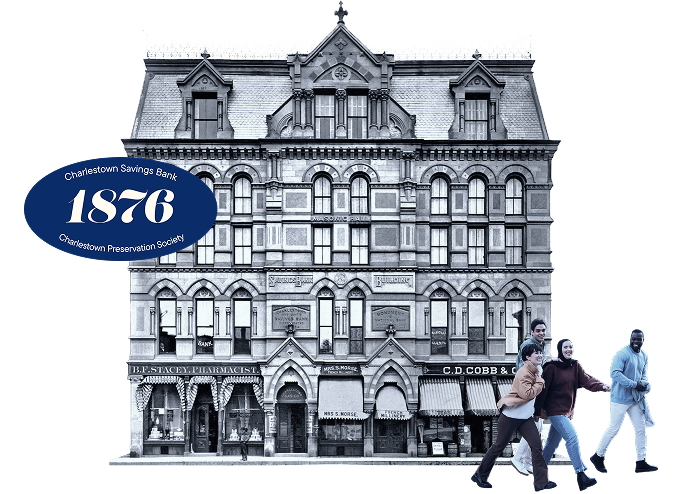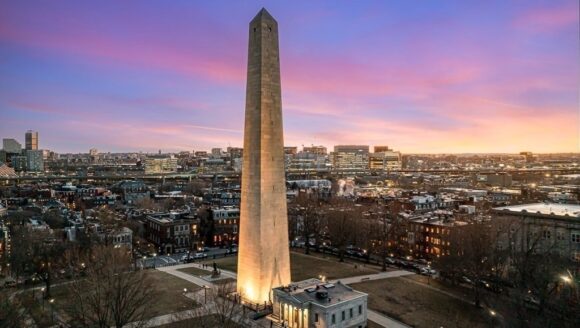
By now, you’ve probably heard about the Monument Square Landmark District Study from a public meeting, social media, flyers around town or word of mouth. As with all community efforts, there are a number of explanations, opinions, truths and falsehoods out there, so we hope to clarify some of the key issues.
Monument Square has been recognized as historically significant to the United States for its urban plan and its contribution to the development of the neighborhood, state and nation. The division and sale of the house parcels were the financial means by which the Bunker Hill Battlefield was preserved, and the Monument erected. Its development changed Charlestown from a village to an urban environment, in turn, contributing significantly to the development of the state and nation.
Today, the buildings within the Monument Square District are protected from adverse effects from Federally funded projects. Like much of Charlestown, a historic neighborhood zoning overlay provides guidelines for alteration of things like rooflines and window patterns.
However, these historic buildings are not protected from demolition, and can be demolished after a 90-day demolition delay. As part of our mission, it is our responsibility to protect the history of Monument Square for future generations.
The Boston Landmark Commission has created a committee to study the district, define boundaries and parameters, to see if there is value to the effort. The process takes anywhere from 12 – 18 months to complete, and it is just getting started with a series of committee meetings that are open to the public.
Following are some of the frequently asked questions that have arisen to keep you in the know!
Will my property be subject to design review if the Landmark District is created?
Yes, if your property has a Monument Square address, and it falls within the final Landmark District boundary (which is still being established), visible exterior changes, new construction, and demolition would generally be reviewed by the BLC.
Interior work and routine repairs in-kind are typically exempt, and the Monument Square standards will spell out exactly what needs review.
No, if a protection area is established and your home falls within the final protection area boundaries, visible exterior changes would not be reviewed by the BLC. New construction and demolition of buildings within the protection area would generally be reviewed for size and massing by the BLC.
Will a Landmark District force me to change my existing building to meet new standards?
No. Landmark District standards apply prospectively to new work, not retroactively to existing lawful conditions. Existing conditions and materials that were legal when installed are typically allowed to remain as “existing nonconforming” or “grandfathered” conditions. Property owners are not required to replace or upgrade existing windows, doors, siding, or other features solely to comply with new district standards unless and until they choose to alter or replace them.
If my building already has non-historic or out-of-character features, will I be forced to remove them?
In general, no. Non-historic alterations that are already in place when the district is designated are not automatically required to be removed. If and when an owner proposes changes to those features, the BLC would then review the new work against the district’s standards, often encouraging more historically compatible solutions but not mandating immediate changes to existing conditions.
How will this change the current BPDA design review process?
Today, many Monument Square projects go through BPDA design review under the Neighborhood Design Overlay, where standards are applied through zoning and staff interpretation on a case-by-case basis. After designation, BLC certificates would become the primary design-review approval in the district, using clearly adopted Monument Square standards and criteria (established by the Study Committee made up of neighborhood and district residents) rather than case‑by‑case interpretations by different BPDA reviewers.
What kinds of work are likely to be reviewed by the BLC?
Typical BLC review covers:
-
- Exterior changes visible from public ways (windows, doors, porches, cladding, additions).
- New construction, infill buildings, and major additions.
- Demolition or partial demolition of structures.
Routine maintenance in-kind and interior alterations that do not change visible exterior features are usually exempt or handled with an expedited staff sign‑off.
Who serves on the Monument Square Landmark District Study Committee?
The Study Committee includes six Charlestown residents—among them at least one Monument Square property owner and the Charlestown Neighborhood Council precinct representative—plus five Boston Landmarks Commissioners. One Boston Landmarks Commissioner also lives in Charlestown. Guided by what is possible through the Boston Landmarks Commission’s enabling legislation, this group is responsible for developing the draft boundaries, standards, and criteria and bringing a recommendation forward for public discussion.
What is the timeline for decisions?
The Study Committee is working now and anticipates presenting a draft framework for boundaries, any Protection Area, and proposed design-review standards for public feedback in Spring 2026. Any final designation would follow additional public meetings, formal hearings, and votes according to the City’s landmark designation process.
How can I stay informed or give feedback?
Property owners and residents can view the petition, draft study materials, and meeting notes, and sign up for email updates and public meeting notices through the Monument Square Landmark District Study page on the City’s website. Written comments can be submitted to BLC staff at any time during the study, and there will be structured opportunities for testimony once a draft designation report is released. On the site, there is also an email sign-up if you want to be informed as meetings or updates are announced.
Contact Us
Interested in learning about the history of Charlestown, or getting involved? We'd love to hear from you!