Why Charlestown’s Finest Greek Revival House Deserves Landmark Protection
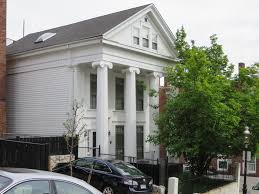
If you’ve ever walked up Cordis Street and stopped to look at the white-columned house set back from the street on the slope of Breed’s Hill — the one with the tall Ionic columns and the low pediment — you’ve probably had the same reaction most people do: wait, what is that?
That’s 33 Cordis Street. It’s known as the Swallow Mansion. And as of the Boston Landmarks Commission’s hearing on May 12, 2026, it is one step closer to being protected as an official Boston Landmark. This is news worth celebrating — and understanding. Here’s what this building is, what landmark designation actually means, and why the Charlestown Preservation Society has been working on making this happen.
What we know about the house:
The Swallow Mansion was built in 1845. It’s a Greek Revival temple-form house — which is a fancy way of saying it was built to look like a classical Greek temple, with a full set of columns across the front, a wide triangular pediment above, and a monumental porch that rises two full stories.
Greek Revival was a very popular style in the 1830s and 1840s — Americans were obsessed with ancient democracy, and it showed in their architecture. But while Greek Revival houses are common in New England, the specific sub-type at 33 Cordis — the temple-front form, with a full-height columned porch, monumental fluted Ionic columns, and a classical entablature — is rare. In all of Boston, only a handful of houses share this form, and 33 Cordis is one of the best examples.
The building was constructed by William H. Bacon, a builder listed in city records as a “painter” — a term that in mid-19th-century New England was sometimes used interchangeably with housewright or builder. The lot was purchased on January 14, 1845 for $1,200. Bacon never lived there himself; within a few years the house passed to a series of owners before finding its long association with the Swallow family.
What makes the building even more remarkable is how it sits. Set back from the street on the steep incline of Breed’s Hill, elevated on a high brick basement and framed by a granite block retaining wall, the house is literally displayed — presented to the street like an exhibit. On a clear day you can see it from a block away. The Boston Landmarks Commission’s own Study Report calls it a building that “projects authority, permanence, and cultural aspiration.” Nearly 180 years later, it still does.
The house takes its name from Amaziah N. Swallow, a grocer who became one of its most prominent long-term owners, and his son George N. Swallow, who was a grocer, politician, and campaign manager in Charlestown in the latter half of the 19th century. The Swallows were part of the merchant and civic elite that shaped the neighborhood’s upper-hillside residential character in the Victorian era; the same class of families whose Federal and Greek Revival mansions gave Cordis Street, High Street, and Monument Square their architectural identity.
The Mansion was constructed at a moment of real social tension in Charlestown. The hillside above the working waterfront was being developed as an upper-class residential enclave, partly as a deliberate counterpoint to the growing Irish immigrant population arriving in the neighborhood’s lower streets. The Swallow Mansion was a statement of aspiration and permanence in that context.
But the story doesn’t end there. And the rest of the story is just as important.
A House That Tells Two Stories
In the early twentieth century, the Swallow Mansion was converted from a high-style single-family home into a multifamily residence — and the families who moved in were Irish immigrant families working their way into stability and civic life. The architectural modifications that came with that conversion are subtle, but they’re legible if you know what to look for: the entrance treatment changed, interior spaces were reorganized, the building adapted to serve new residents with different needs.
Those changes were never erased. They’re still visible in the building’s fabric today. And that, in the view of the Boston Landmarks Commission’s Study Report — and in CPS’s own assessment — is what makes 33 Cordis Street unusually significant as a historical document.
This dual narrative — elite aspiration and immigrant adaptation, both visible in the same building — is precisely the kind of complex, complete historical record that landmark designation is designed to preserve. The Swallow Mansion tells a story that no other building in Charlestown tells in quite this way.
The Boston Landmark Commission will be holding a virtual public hearing on May 12, 2026 at 6:00 pm to vote on the proposed designation during its regular session. Members of the public are invited to attend this hearing and provide comments. Any comments can be directed to the BLC – blc@boston.gov; or you can participate in the hearing via Zoom.
Contact Us
Interested in learning about the history of Charlestown, or getting involved? We'd love to hear from you!