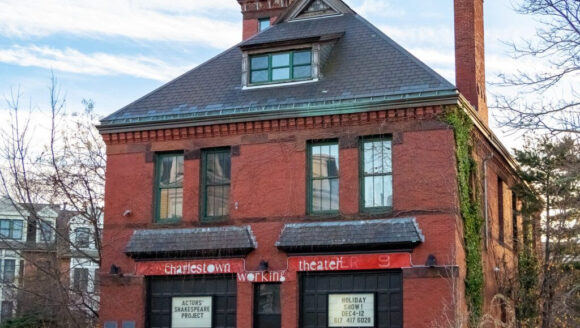
Built in 1884, 442 Bunker Hill Street was once home to Boston Engine Company No. 32, and for nearly a century it was a working fire station, through the days of horse-drawn engines and into the early years of motorized firefighting. When the Engine Company moved to Main Street in 1970, the building got a second act. It was converted into a theater during the 1970s, and in 1976 the Charlestown Working Theater (CWT) was founded.
Maintaining a historic building and operating a theater and its programs at the same time isn’t easy. So, CWT reached out to the Charlestown Preservation Society for help in restoring the building. We helped CWT identify the right team members, Preservation Architect Scott Winkler of Wessling Architects, to assess the building and its needs, and CPS’ Mark Allen and Amanda Zettel assisted in identifying and applying for grant funds.
Today, the theater is well into its second act with the support of a Boston City Council grant approved in April 2026. The $213,172 Community Preservation Act (CPA) grant will help restore the building’s historic windows and doors, and we at the Charlestown Preservation Society are proud to have helped make it happen.
What the grant covers
Over the next two years, the grant will help replace the building’s exterior windows and doors with historically appropriate versions that meet preservation standards. At the same time, the entrances will be updated in accordance with current building, energy and accessibility codes.
That combination is the heart of good preservation: keep what makes a building special, and make it work for the people who use it today. From the street, the 1884 firehouse will keep its historic look. Inside, it will be more energy efficient and easier for everyone to get into, whether they’re coming for a show, a music lesson or a community gathering.
This isn’t the first CPA investment in the building. CWT previously received a CPA stabilization grant that supported early preservation work on the 19th-century structure. The windows and doors were identified as the natural next phase of care.
Where the money comes from
Boston voters adopted the Community Preservation Act in 2016. It’s funded by a dedicated 1% property tax surcharge, paired with annual matching funds from the statewide Community Preservation Trust Fund. In other words, it’s local money reinvested in local places. CPA dollars can go to only three things: historic preservation, open space and affordable housing.
Third time’s the charm
This one took persistence. It was our third time applying for this grant, and this time we were approved.
Securing CPA funding is a multi-step process. Projects first have to pass an eligibility stage and prove their historical value, which often involves review with the Boston Landmarks Commission. Only then can a full application go in. Our latest application reached the Community Preservation Office in November 2025. From there it was reviewed by Community Preservation staff, recommended by the Community Preservation Committee, and moved through the city’s development committees and the Mayor’s office before going to the City Council for a final vote.
Throughout, we worked side by side with CWT’s Executive Director Kristin Johnson and Tony Viveiros to match their needs with the City’s preservation rules, gather the project paperwork and put together a strong proposal. Scott Winkler and Wessling Architects is also working with us to provide architectural guidance, so the window and door work meets federal historic rehabilitation standards.
How the money is paid out
CPA grants don’t arrive as a single check. The City manages each award through a formal Grant Agreement and pays out based on progress and expenses. Once the agreement is signed and a pre-construction report is approved, the City typically releases an initial payment of up to one-third of the award to get work started. Further payments follow as work is finished, after the project team submits paid contractor bills, proof of spending and progress reports showing the work meets historic standards. A final portion, typically around 10%, is held back until every window and door is installed, inspected and signed off in a final report.
Because the grant covers part of the project, these CPA dollars will be paired with other project funds to complete the full job.
A neighborhood that showed up
Every CPA application needs to show community support, and Charlestown delivered. Four letters went in on CWT’s behalf:
- Charlestown Preservation Society. Guided by the expertise of CPS member, Mark Allen, we pointed to the architectural value of the 1884 firehouse and how its restoration connects to other local CPA projects, including the Peace Park, Memorial Hall, the Kennedy Center, the U.S.S. Constitution Museum, local playgrounds, the Little Mystic and next-door neighbor Gardens for Charlestown. Together, they form a connected block between Bunker Hill and Charlestown Neck.
- Gardens for Charlestown. Writing as CWT’s nonprofit next-door neighbor, they described how the theater brings together residents of all ages and backgrounds through its arts programs.
- North End Music & Performing Arts Center (NEMPAC). NEMPAC explained how CWT and owner Kristin Johnson host the organization at 442 Bunker Hill Street, partnering on weekly music lessons and arts programs for local kids, adults and seniors, and connecting area schools, businesses and nonprofits.
- Boston City Councilor Gabriela Coletta Zapata (District 1). The Councilor backed CWT’s history of serving Charlestown’s cultural needs and encouraging community conversation across Boston.
The long view
New windows and doors may not sound glamorous, but they’re what keep a historic building weathertight, efficient and welcoming. Over the two-year grant period, this work will preserve the firehouse’s historic face while improving energy efficiency and public access. In the long run, it supports the ongoing care of the building, so CWT and its partners can keep running the community arts programs that fill it.
The last engine left 442 Bunker Hill Street more than fifty years ago. Thanks to the CPA, and to everyone who wrote letters, reviewed plans and stuck with this project through three applications, the old firehouse will keep bringing Charlestown together for years to come
Contact Us
Interested in learning about the history of Charlestown, or getting involved? We'd love to hear from you!