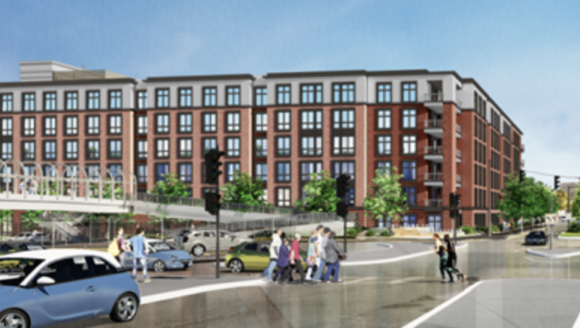
As a follow-on to PLAN: Charlestown and other developments in the town, recent attention has turned to the development of 201 Rutherford Avenue. The project comprises a mix of residential and commercial space abutting the current Bunker Hill Mall. Recently, the Charlestown Preservation Society’s Design Review Committee took a look at the proposal and has submitted the following feedback to the BPDA:
The Charlestown Preservation Society Design Review Committee (DRC) has reviewed the current Draft Project Impact Report (DPIR) and related presentations for 201 Rutherford Avenue (Building A and long-term site concept) submitted by New England Development and Elkus Manfredi Architects. We have compared this iteration against our March 9, 2021 Project Notification Form comments and conducted a detailed working session to identify progress made, issues partially resolved, and critical concerns that remain unaddressed.
We appreciate the proponent’s efforts to respond to several key recommendations from 2021, including reducing building height, increasing setbacks, expanding public realm, reconnecting Lawrence Street, and improving façade articulation. Building A has been reduced from 85 feet / 7 stories to approximately 70 feet / 6 stories, with setbacks of roughly 43 feet on Rutherford and 24 feet on Austin that allow wider sidewalks, trees, and vegetated buffers; the formerly monolithic façade is now broken into vertical bays with step‑backs, balconies, varied brick, and a differentiated attic story, and West School Street includes true walk‑up units with multiple doors, stoops, and small gardens that create a townhouse rhythm appropriate to Charlestown; the public realm has roughly doubled, adding a pocket plaza at Rutherford/Austin, widened sidewalks, preservation of four mature honey locusts, and approximately 25 new trees in an “urban forest” canopy strategy; loading, trash, and about 70 parking spaces are internalized within Building A, an existing driveway was closed to improve pedestrian and bicycle safety, and mall‑associated public parking is maintained at its current 235‑space supply; and the project now targets net‑zero carbon, all‑electric systems, LEED Gold, and Passive House‑level performance, with low‑carbon materials, pollinator‑supporting vegetation, and heat‑island mitigation measures that exceed what was contemplated in 2021 and merit support if rigorously documented and conditioned.
However, the current submission still falls short of meeting Charlestown Preservation Society’s expectations for comprehensive master planning, appropriate ground-floor programming, pedestrian connectivity, and contextually appropriate design. This letter outlines where the proposal has improved, where further revisions are required, and the conditions under which CPS could support this redevelopment.
- Master Plan and Program Requirements Still Unmet
Despite these improvements, the current submission remains fundamentally incomplete and continues to sidestep the most important planning concern raised in our 2021 letter: the absence of a comprehensive, formally submitted master plan for the entire 6-acre Bunker Hill Mall site. Without this level of detail, the community has no assurance that the redevelopment of the Mall site to accommodate residential uses will retain and expand the centralized retail and service hub that serves the community.
Partial Plans Are Not Acceptable
The proponent describes a long-term vision with four buildings (A, B, C, D), continuous Main Street retail, a relocated grocer in Building B, additional residential in Building D, and significantly expanded open space. However, only Building A is fully designed and filed. Buildings B, C, and D remain conceptual, with no phasing, firm massing diagrams, heights, unit counts, streetscape elevations, or ground-floor use plans provided for Austin Street, Main Street, or West School Street frontages in later phases.
This approach—presenting an informational “vision” in lieu of a formal master plan—is precisely the kind of incremental, project-by-project rezoning and approval that CPS opposed in 2021 and continues to oppose now. We reiterate our request that the BPDA require a complete master plan submission before approving Building A or any zoning amendments. Similar to those required of Hood Park, Austin Lots and Bunker Hill Housing Development, the master plan must include:
- Massing diagrams, heights, and building footprints for all four buildings
- Ground-floor use plans showing retail, shopping and food service frontages on all public streets
- Phasing and construction timelines
- Alternative parcel configurations and program scenarios demonstrating how the site can accommodate neighborhood-serving uses while respecting scale and context
- An interim activation plan for Main Street commercial frontages during phased construction, ensuring existing businesses remain viable and visible throughout the redevelopment process
Without this level of detail, the community has no assurance that future phases will deliver the promised retail diversity, public realm improvements, or contextually-appropriate massing.
Ground-Floor Program Violates Urban Renewal Intent
This site’s zoning and urban renewal designation were intended to provide neighborhood shopping—a centralized retail and service hub that replaced the finer-grained commercial fabric eliminated by urban renewal. While this is an ideal site to add residential units, buildings A and D, as currently proposed, are primarily residential at grade, with limited active frontage, loss of restaurant and retail space, and no new retail.
This represents a programmatic shift away from the site’s fundamental purpose and results in:
- A net loss of storefront variety and retail diversity
- The elimination of the Ninety Nine Restaurant, and what appears to be other retail space, with no replacement restaurant space proposed anywhere in the master plan
- Ground-floor uses on Austin Street that are internalized (lobby, amenities, mechanical) rather than active and public-facing
CPS’s position is clear: ground-level uses on this urban renewal parcel must remain predominantly public-serving (retail, restaurants, services, community space) with residential uses above. We strongly urge the proponent to redesign Buildings A and D to include active retail bays for all ground level uses, and to incorporate a replacement restaurant of comparable size and rent structure to the Ninety Nine.
Coordination with PLAN: Charlestown
In 2021, we requested that significant zoning changes be deferred until the completion of PLAN: Charlestown, so that rezoning could be handled comprehensively rather than on a case-by-case basis. PLAN: Charlestown’s core purpose is to “accommodate new contextually appropriate housing growth along the Rutherford Avenue Corridor and in Sullivan Square while preserving the character of its existing residential areas,” and to coordinate land use with infrastructure, mobility, open space, climate resiliency, affordable housing, and historic preservation. It provides a “vision and ceiling for growth” in the corridor, setting height/FAR ranges, open‑space targets, and mobility upgrades.
While this project implements several core PLAN: Charlestown goals, it falls short of the PLAN’s intent on planning transparency and ground‑floor public use: the lack of a fully detailed master plan for the entire mall, the heavy weighting of residential and private building space at grade on Austin and Rutherford Streets, and in Buildings A/D, and in the decrease of small neighborhood retail and dining spaces in this critical gateway site.
III. Design, Operations, and Connectivity Revisions Required
Beyond master planning and programming, several critical design and operational issues require resolution before CPS can support this project.
Grocery Layout, Parking Strategy, and Loading Operations
The long-term concept places the grocer in Building B with one story of retail, one level of parking above, and photovoltaic panels on the roof. While we support structured parking over surface lots, CPS strongly prefers that grocery parking be located below grade to activate Austin Street at ground level, eliminate unsafe and unsightly ramps, and take advantage of the existing ~8-foot below-grade condition of the site.
Additionally, the current materials do not adequately demonstrate how grocery operations will function without obstructing streets or creating circulation conflicts. We request that the proponent provide detailed plans showing:
- Loading dock locations, truck turning radii, and service schedules
- Dedicated pickup zones for grocery customers and ride-hail vehicles
- Clear separation of pedestrian, bicycle, service, and passenger vehicle movements
- Strategies to screen or internalize ramps and avoid at-grade parking lots visible from public streets
These operational details must be resolved at this stage, not deferred to later phases or left to property management after occupancy.
Pedestrian Connectivity and Bridge Strategy
The revised site plan improves internal pedestrian circulation with raised, flush sidewalks and marked crossings on the access way. However, Building A blocks the existing direct pedestrian desire line from the MBTA Community College station to Whole Foods and other Main Street destinations. A separate public works project for Rutherford Avenue is already in design and is expected to deliver safe, at‑grade pedestrian crossings; in this context, CPS believes the existing pedestrian bridge is no longer needed and should be removed as part of the Rutherford Avenue project rather than perpetuated or rebuilt in conjunction with 201 Rutherford. To preserve the critical pedestrian connection through the site as the bridge is phased out, CPS requests that the proponent incorporate a clear, publicly accessible pedestrian pass‑through corridor within Building A (through the garage or ground floor) that directly connects Rutherford Avenue to the interior of the shopping center, maintaining this desire line as the site is redeveloped.
Austin Street and Rutherford Avenue Corner Treatment
The proposed pocket plaza at the Rutherford/Austin corner is intended as a welcoming gateway element. However, we are concerned that the current design—featuring hard benches, limited shade, and decorative elements will be ineffective as public space: too exposed to traffic, too hot in summer, and lacking the greenery and comfort that invite pedestrians to linger.
We recommend that the corner plaza be redesigned to prioritize:
- Substantial shade trees with adequate root volume and canopy spread
- Seating integrated with planting rather than exposed concrete benches
- A Charlestown welcome feature or neighborhood wayfinding element that celebrates local history, our small businesses and identity, rather than abstract decorative gestures
- Deeper planting zones and permeable surfaces to support stormwater management and urban cooling
The Austin Street sidewalk and building setback, while improved from 2021, are still too narrow given the intensity of the corner and the importance of this western gateway. We encourage the proponent to explore pulling the building back an additional 10–15 feet on Austin Street to create a more generous, landscaped entry sequence.
Utilities, Below-Grade Infrastructure, and Building Base
Questions remain about the location and acoustic treatment of electrical equipment, transformer vaults, and mechanical systems, and whether below-grade space is being fully utilized to free the ground plane for active, public-facing uses.
We request:
- A utilities and MEP location plan showing transformer locations, noise mitigation measures, and screening strategies
- A comparative study of below-grade vs. above-grade parking scenarios, with cost-benefit analysis and design implications for ground-floor activation
- Consideration of raising the retail base to match Rutherford Avenue grade, relocating private building amenities to upper floors, and pulling residential units back at the second floor to create a taller, more prominent retail podium
These design moves would better align the building with urban design best practices, activate Austin Street, and create a more inviting connection to Main Street businesses.
- Façade, Passive House, and Livability Conditions
While the revised façade represents an improvement over the 2021 scheme, committee feedback indicates that the building still reads as generic, overly conservative, and not sufficiently responsive to Charlestown’s architectural character.
Façade Refinement and Contextual Design
The current design employs varied brick colors, balconies, and an attic story to break down massing. However, the overall composition—particularly along Rutherford Avenue—is perceived as repetitive, lacking the warmth, detail, and contextual specificity that distinguish successful infill projects in historic neighborhoods. We encourage the design team to:
- Study successful Charlestown precedents (historic rowhouses, contemporary infill at and Navy Yard adaptive reuse) to identify texture, proportion, and material strategies that feel authentically local
- Refine window proportions, mullion patterns, and brick coursing to reduce monotony
- Explore differentiated base, middle, and top treatments that reinforce the neighborhood’s traditional tripartite façade composition
- Provide physical or digital mock-ups of key façade sections for community and design review
Passive House Performance and Glazing Ratios
The proponent advertises Passive House-level performance goals, but committee members have noted that the façade appears to have excessive glazing, raising concerns about constructability, thermal performance, and compliance with energy code and Passive House Institute standards (which typically limit window-to-wall ratios and require high-performance detailing at jambs, sills, and spandrels).
Interior Courtyard Livability
Building A includes an interior “open-to-sky” amenity courtyard described as serving interior residential units. Committee members have expressed concern that this courtyard functions primarily as a light well for units that would otherwise lack adequate daylight and air, and that the configuration may be too narrow or constrained to provide genuine livability for occupants.
We request:
- A daylight and shadow analysis showing solar access to courtyard-facing units at winter solstice, equinox, and summer solstice
- Floor plans and unit layouts demonstrating how residents access and use the courtyard
- Clarification of courtyard dimensions, programming (seating, planting, amenities), and egress paths
- Consideration of relocating amenity spaces to upper floors or rooftops and reconfiguring the ground floor to support active uses rather than compensating for constrained unit layouts with a narrow courtyard
If the courtyard cannot provide comfortable, well-lit, and usable open space for residents, the unit mix and building footprint should be reconsidered.
- Conclusion and Recommendations
The Charlestown Preservation Society appreciates the proponent’s responsiveness to several key concerns raised in our 2021 comment letter, including reductions in height, increases in setbacks, expansion of public realm, and commitments to sustainability. However, the current submission remains incomplete and does not meet the threshold for CPS support or approval.
We ask that the BPDA:
-
- Require submission and approval of a formal, comprehensive master plan for the entire 6-acre site before approving Building A or granting zoning relief for conditional uses.
- Condition any approvals that ground-floor uses are located at street level, that they remain largely public, commercial, and community-serving and that any ground floor residential and “private to building” spaces be kept to a minimum at Rutherford / Austin and Main show that it will not displace or preclude needed neighborhood retail and services in the shopping center.
- Require a commitment to replace the lost restaurant space.
- Require detailed operational plans for grocery loading, parking, and pickup logistics, with a preference for below-grade parking to activate Austin Street.
- Require a mapped, publicly accessible pedestrian pass-through preserving the MBTA station–to–neighborhood shopping connection.
- Coordinate the pedestrian bridge evaluation and potential removal with the Rutherford Avenue at-grade redesign.
We urge the BPDA to work with the proponent to address these concerns comprehensively before moving forward. Charlestown deserves thoughtful, context-sensitive development that honors our neighborhood’s historic character, supports local businesses, and creates genuinely public and welcoming streets and open spaces.
Any and all feedback is due to the BPDA by March 16, 2026 and can be uploaded here.
Contact Us
Interested in learning about the history of Charlestown, or getting involved? We'd love to hear from you!