As the country’s 250th birthday approaches, the City of Boston’s Archaeology Program has launched a dig on the grounds of the Bunker Hill Monument. The effort is beautifully chronicled in the latest issue of Archaeology magazine in a piece entitled “In the Shadow of Bunker Hill.”
A Town of 1,500 — And Almost No One Remembered
Before the British army set fire to the neighborhood in 1776 Charlestown was a thriving, centuries-old community of between 1,500 and 2,000 people. They were farmers and artisans, mariners and merchants, free Black residents, enslaved people, women who ran businesses, and craftsmen whose work supplied all of colonial Boston. It was almost 150 years old on the day it burned.
The article describes how City of Boston Chief Archaeologist Joe Bagley and his team have spent years reconstructing who, exactly, lived here. Using historical documents — deeds, tax records, property loss claims filed by displaced residents — they have built what amounts to a reconstructed 1775 census of Charlestown, paired with a detailed map of where each household stood before the fires. Think of it as bringing an entire lost city back to life on paper — before going to find it underground.
The goal, as Bagley has described it, is to tell the stories of those who have gone underrepresented in the standard narrative of the Battle of Bunker Hill: women, children, people of color, Native people, and the working poor who lost absolutely everything and rarely appear in the history books.
“There are stories about everyday people, who were in the town of Charlestown, who saw their lives change in one morning, who ran out their doors and came back to literally nothing,” Bagley said in a separate interview. “And I think that’s really the human story of the impacts of war.”
The Dig That’s Happening Right Now
Right now, you probably see the tents, the trenches and the orange cones that show archaeologists actively excavating Breed’s Hill — the actual site of the June 17, 1775 battle — in search of the redoubt: the earthen fortification that Colonial soldiers hastily dug by hand in a single night before the British assault.
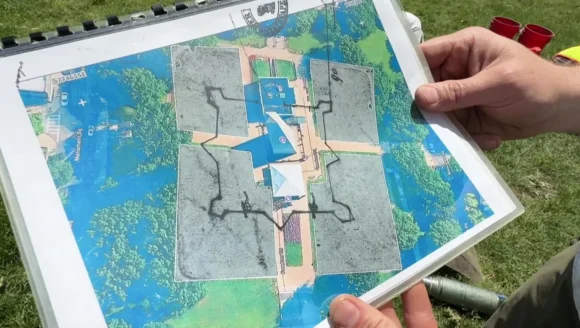
Every historical map of the redoubt disagrees with the others on its exact location. Ground-penetrating radar surveys have identified the most promising spots, and the team is now excavating two trenches to pinpoint the fortification once and for all. Among the artifacts already recovered: a gun flint — used to fire an 18th-century musket — that almost certainly dates to the battle itself.
A forensic anthropologist is standing by at the site, because the possibility of finding fallen soldiers — American and British — within or near the redoubt is described as very real. The team has committed to halting excavation immediately if any human remains are encountered.
Why This Matters for Preservation in Charlestown Today
At the Charlestown Preservation Society, our work is rooted in a simple belief: you can’t protect what you don’t understand. Every Historic Marker we install, every house we research, every development proposal we review — all of it depends on knowing the layered history of this neighborhood.
The archaeology underway is exactly that kind of foundational knowledge — and it connects directly to what we see in Charlestown every day. The City Square area, the Training Field at Winthrop Park, the slope of Breed’s Hill visible from Bunker Hill Street — these are not just scenic backdrops. They are active historic landscapes..
Read the Full Article
“In the Shadow of Bunker Hill” by Jason Urbanus was published in the July/August 2026 issue of Archaeology magazine. Read the full piece here: archaeology.org — “In the Shadow of Bunker Hill”
Contact Us
Interested in learning about the history of Charlestown, or getting involved? We'd love to hear from you!