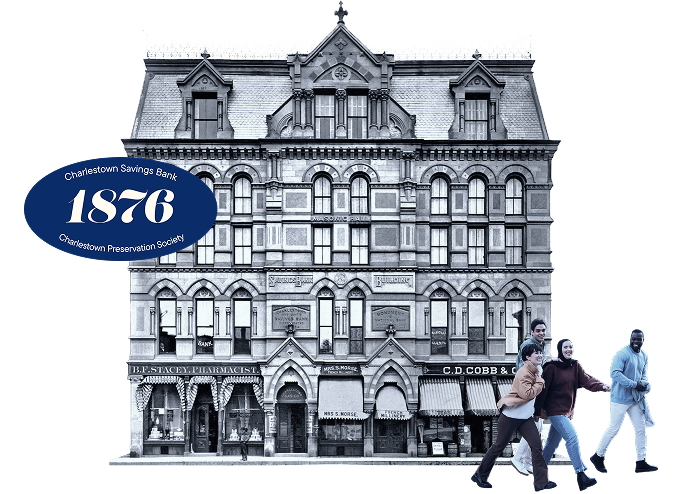
The Charlestown Preservation Society was founded in the 1960s in response to a period of intense redevelopment pressure in Charlestown. As large-scale urban renewal plans threatened to remove many of the neighborhood’s older buildings, a group of residents began organizing to protect Charlestown’s architectural heritage, historic streetscape, and sense of continuity.
By 1966, Vincent Strout, then president of the Charlestown Historical Society, and other members recognized the need for a committee to monitor Boston Redevelopment Authority activity in the neighborhood. That committee soon took on a broader role, and in 1967, the Charlestown Preservation Society was incorporated as an independent organization.
The Society’s first leadership included Douglas Adams as president, Richard Creaser as vice-president, Virginia Creaser as secretary, Wylie Van Wart as treasurer, and Genevieve MacDonald as corresponding secretary. Other founding members named in the record include William Steck, Gordon Milde, John Nichols, Samuel Donnell, Oren McCleary, Laurette Murdock, Elizabeth Smith, Robert Severy, Richard Woods, and Earldine Woods.
A preservation mission
From the beginning, the Society’s purpose was clear: to restore buildings of architectural and historic merit in Charlestown and to support quality planning that would preserve the traditions of beauty, sound construction, and village life that had long characterized the neighborhood. This was not preservation in the abstract. It was a response to the real and immediate threat of demolition, dislocation, and the loss of historic fabric.
One of the Society’s most important early successes was helping persuade the Boston Redevelopment Authority that the Thompson Triangle could be restored. Bounded by Pleasant, Main, and Warren Streets, the area contained some of Charlestown’s oldest and most historically significant structures. For the Preservation Society, saving the Thompson Triangle demonstrated that historic rehabilitation could be both practical and meaningful.
The Thompson Triangle
The Thompson Triangle became a defining preservation project in Charlestown. Among the buildings associated with its rehabilitation were the Timothy Thompson House at 9 Thompson Street, the Benjamin Thompson House at 119 Main Street, the Warren Tavern at 2 Pleasant Street, the Round Corner House at 121-123 Main Street, and the Armstrong House at 125-127 Main Street.
Additional restoration work in the same area included the Hurd House at 67 Main Street, built in 1795, and the Austin House at 92-98 Main Street, both restored by Historic Boston, Stanley Smith Director and William P. Lamb was the architect on the Hurd House. Across Warren Street, Samuel W. Donnell restored the Federal house at 81 Warren Street, along with the houses behind it at 81 ½ and 81 B, now known as Donnell Court, while Laurette P. Murdock restored the Federal house at 85 Warren Street.
Legacy and meaning
The Charlestown Preservation Society emerged at a moment when residents understood that preserving buildings meant more than saving old walls. It meant protecting neighborhood memory, architectural continuity, and the public value of places shaped by generations of Charlestown life. The Society’s work helped establish preservation as a serious civic practice in the neighborhood, one grounded in research, advocacy, and long-term stewardship.
That legacy remains especially relevant in a neighborhood that continues to change. Preservation can raise difficult questions about affordability, belonging, and who benefits from reinvestment. A careful reading of Charlestown’s preservation history suggests that the strongest stewardship is not possessive or exclusive, but informed, respectful, and attentive to the people who have sustained the neighborhood over time.
Contact Us
Interested in learning about the history of Charlestown, or getting involved? We'd love to hear from you!